×

Hi there! This is a work in progress website revamp. The old one is totally gone but archived and I don't wanna deal with that mess hahahah.

This biweekly update: about + ODODI page + index

While I have this funny popup, HEY!!!! Follow me on:

YouTube,

Bluesky,

Cara,

Sheezy,

Artfol,

And join the Discord of Dreadful Ineptitude if ya like the series!

Return

LORE ARTICLE // AURAL GEOMORPHOLOGY //

A nerd hyperfixates and rambles about magic's influence on the formation of terrain.

RUNES & AURA IN

geomorphology


An absolute idiot's understanding and fascination with auraflow and how it interacts with geomorphology to create the natural beauty of our planet. Waterfalls are fucking metal.

Aura plays just as big a role in the surface of Kaaldenvale as air, water, and animals. It's not just a force that we draw out of the ether to employ, it is so much more than that, and I wish more people knew it. It's moved and changed things this entire time, and geologists are only just beginnning to dig into how it's influenced our world without our hand.

So, I'm here to tell you all about the little bit of research I did and just how fucking cool it is.


CONTENTS

I [ AURAFLOW & EROSION

II [ FAEVINITY COPIES NATURE

III [ WILD RITUALS MAKE MIRACLES

IV [ PRACTICAL APPLICATIONS

V [ SOURCES & CONTEXT

NOKA ACQUIESCE!

I [ Auraflow & Erosion


So, I'm really no stranger to the hows and whys of auraflow. I'm an artificer! I make adventurer supplies for a living; imbuing such gear with special functionality requires essentially carving rituals into their fabrics and plates - and ritual patterns and runes are really just divots that guide aura to move and thus behave in specific ways.

But, how does this apply to aural geomorphology?1 Simple - at the base level, it's almost the exact same. You simply need to think of the landscape itself as a ritual pattern. The landscape itself, through normal development, creates channels for aura which then channels (see what i did there ?) it into changing the landscape.

From this, we can surmise that aura flows much like water; it takes the path of least resistance. It can flow deterministically, in predictable ways, which means we can decode how it works its magic across landscapes.

Although most of our technology is based off of sending aura into specific flowing shapes to generate effects, it's not the foundation of how aural geomorphology works - even tho those principles do still apply. Those are called wild runes - we'll talk about them later! Run of the mill aural geomorphological processes run off something much more familiar: erosion2.

You see, aura is not some ethereal force that floats around in the air. It lives on a sublayer of reality - the same way that a drawing is only length and width while you and I carry depth. This dimension, the aurasphere, is the base layer of reality, carrying neither length, width, nor depth. The theory is, frankly, insane and beyond my paygrade, but in summary the aurasphere is the underlying thing on which everything else is built on. Manipulating it manipulates all higher dimensions, which is to say, all of them.3

Therefore, aural movement in the aurasphere can have effects on the physisphere; auraflow can erode physical matter. Due to how little we understand about how things move in the aurasphere and its set of physics (which seem, somehow, divorced from ours), this phenomenon (known as aural erosion) can erode things in weird ways. Giant ravines in the middle of flat plains, perfectly circular ring lakes, etc. Before these revelations, geologists were intensely confused at the almost consistent landforms of our planet.

Aural erosion is what makes our world whimsical.
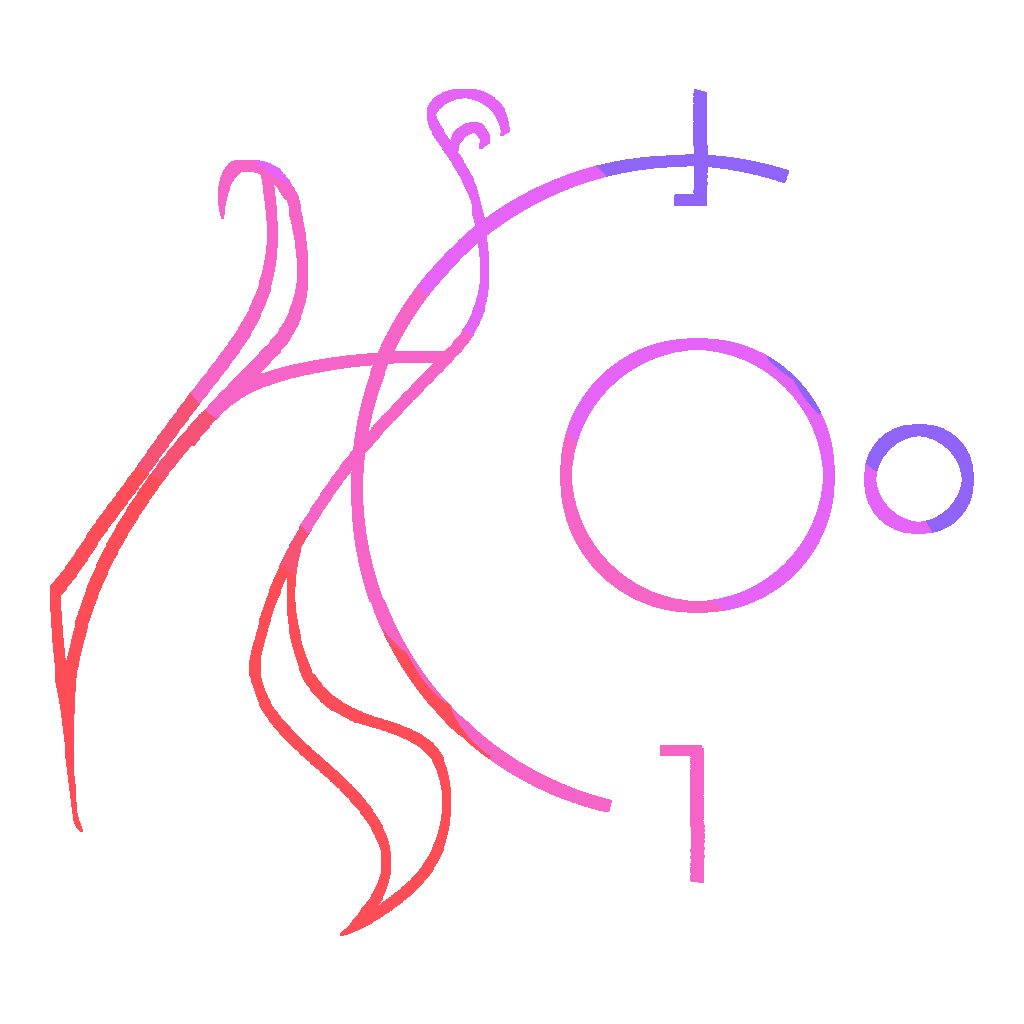
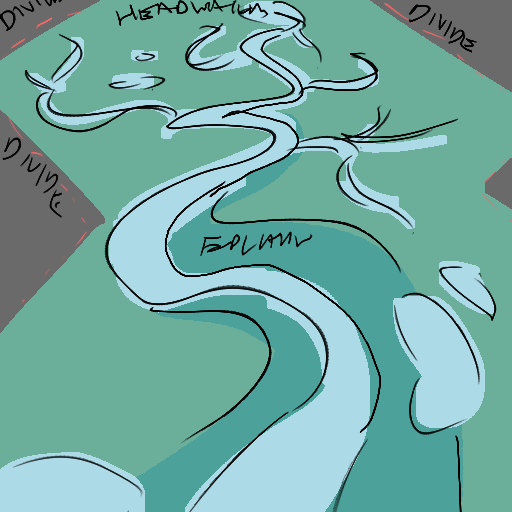
figure i

A simple hypothetical hydrological watershed.

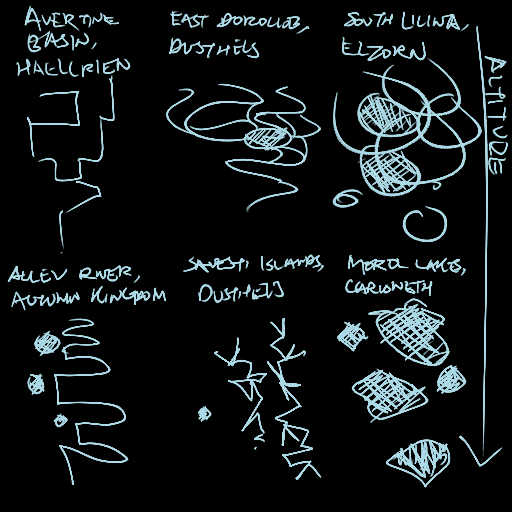
figure ii

Various strange watershed patterns that geologists believe are aura effected.

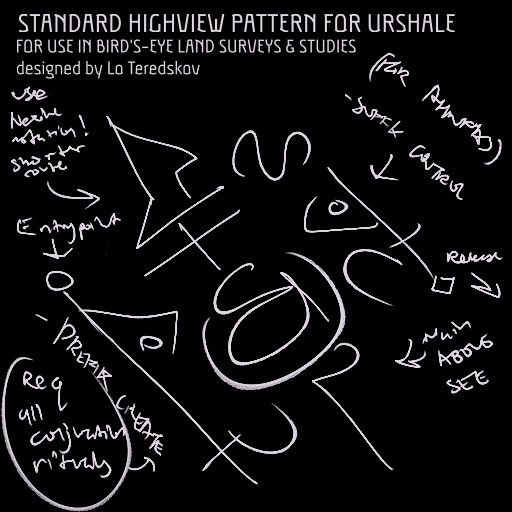
figure iii

A highview ritual diagram, annotated with aural pattern notes.

II [ Faevinity Copies Nature


Aural erosion is all well and good, but it lacks grandeur. True demonstrations of aura's power are far rarer.

It starts with runes. You know, those funny symbols that everyone can somehow read, across every language? Even the animals can read it - though they don't recognize the concepts.4 They're a universal language - and aura knows it as well. If we channel aura through runic patterns, we get reproducible results.

Through this, we're able to reverse engineer how some basic patterns make aura work. A curve at a specific angle followed by a specific cardinally-facing straight line could produce a flame, or a triangle with specific angles conjure dirt... the why behind these rules isn't understood, but we still know their effects. There are whole rune-effect translation dictionaries. That's how most of our technology works.

It's very easy for terrain to inadvertently form individual, simple rune words, especially with how flexible runes are to write (vowel accents going just about anywhere5). Aural erosion even tends to take runic forms - it's just how aura works. These natural rune and ritual shapes are called wild runes (or rituals), and they can replicate what we do with our technology, but several thousandfold.

Ambient aura moves slowly - that's why we get year long seasons of extra mana or mana shortage. Even with a gigantic rune, it is only the magnitude of the aural effects that is amplified, not the speed.6 Over centuries, wild runes can change a place's climate and topography entirely, but it's a slow process. Most of these effects observable today do not have readily apparent runic formations, always under sediment or rock or water. They're ancient.

Geologists have been able7 to identify the potential sites of future wild runes. There is a rune for levitation that is forming in the Seymont mountains in Altegan - which will surely be a sight to see in its prime.8 The Savesti islands shapes may mutate into runes for a multitude of things. The Antimemmnon range in Elzorn is already exhibiting signs of physically unexplainable volcanic activity.

I have never felt more motivated to reach those third digit tiers and their titanic lifespans.

III [ Wild Rituals Make Miracles


Southern Haelcrien used to be shallow ocean - but over centuries of aura flowing through the simple runes for 'above', 'beyond', etc. that formed in parts of the seabed, lines of mountains were slowly grown where there were no tectonic seams, cutting off the water.

While the power of wild rituals is immense, they still follow basic laws of reality. Matter and energy has to be drawn from somewhere. Haelcrien's new mountain ranges dragged sediment away from the center and deepened that area, causing a giant below-sea-level zone framed by mountains. Which begs the question: where did the water go?

All the ocean once seated between the mountains was evaporated away. That's what we think anyway, based on present day remnants of this behaviour. There was once a gigantic miracle of a wild ritual seated on the central Haelcrien seabed, which gave off so much heat that, once it was unable to disperse heat to the rest of the ocean, sent the new sea above back into the atmosphere.

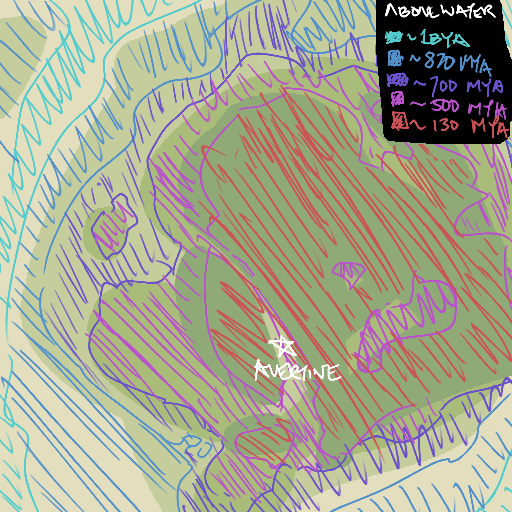
This effect is still noticeable today, even though we can't access and study the wild ritual itself, buried as it is under millennia of strata. The Avertine drainage basin, where the center of Haelcrien is still depressed down, collects most of the upper provinces' water and sends it back into the sky. The capital is built near the epicentre of that basin - it's absolutely magical. You can see the water getting evaporated in real time.

Anyone who's visited the Autumn Kingdom has marvelled at the oases of the Ruryon desert. Grand, beautiful showcases of biodiversity surrounded by thousands of kilometres of empty, scorching sand. Combining the insanity of their existence and the high aura levels, it's believed that the two are correlated. In the same way basalt tends to form square pillars, the Ruryon sand, in an act of great irony, tend to form runes for water and plants.

Tienarte is an even greater magic. Air runes that are currently being excavated out of their sandy tombs, are what's responsible for the breathability of the water around the Isles and have allowed the area to develop a unique ecology. The effect's radius may even expand once we've dug them up and exposed them to the water directly.

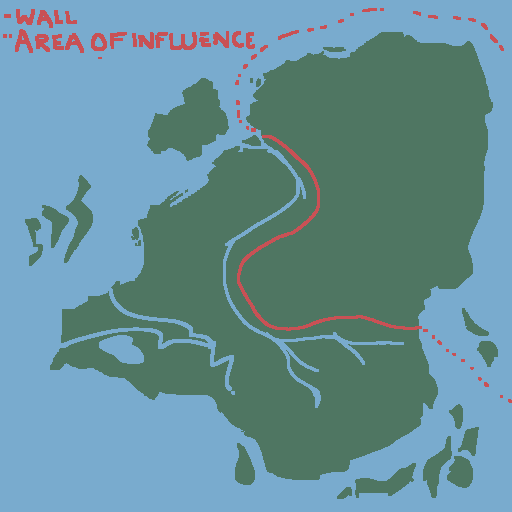
Other major examples of this include the absolutely unlivable environments of Aunper9, Roril and its hyperconcentrated aura10, and it has been theorized that whatever the Dawne Kingdom uses for its unbreakable walls is the work of a wild rune.

figure iv

Historical water levels of the Avertine drainage basin.

figure v

The Dawne Kingdom walls as mapped by cartographers.

IV [ Practical Applications


I'm always excited at the idea of a new trip through nature. To trek through a new place and discover its sights - which, I now know are magical in more than metaphor. I may be lonely in my actual life, but I will always find a companion in nature.

That said, I am an artificer. We tend to think practically, materialistically, heathenously. And aural geomorphology is a gold mine of potential.

Aural erosion has incredible utility for dating landscapes and predicting their ancient climates. Auraflow has historically been linked to weather patterns; clouds and gaseous water are far more malleable than mountains. We've used local auraflows to predict incoming weather down to ~40 square kilometres for massive regions. It's now very common for a local paper to report on weather data for the next month - though precision drops as time moves.

Because of this link between auraflow and weather, we can run weather simulations backwards on a very large scale, match them to aural phenomena, to get a very rough timeframe for when aurally eroded landforms were still being actively formed. Due to the variable length of aural seasons (in the early days of Haelcrien there was an almost three decade long mana drought), precision isn't the greatest, but it's a step in the right direction.

We can also, of course, through going the other way, use the auraflow effects on landscapes to postulate more accurately how the climate was at the time. This helps refine time and date, but is still not the most precise.

Wild runes are a far more nebulous set of possibilities. I've already mentioned the Dawne Kingdom's potential utilization of a wild rune to forge its unbreakable walls - the stones11 are incredibly strong and show signs of high, fluctuating aural density consistent with ambient aural movement. Even so, their sheer size still begs the question of how the hell Dawne built them.

Similar operations are being organized in Deliria, with researchers hoping to make metal strong enough to withstand high-tier monsters using the still-forming volcanic runes in the Savesti Islands, for use by low-tier fae to lessen dependence on adventurers to defend civilization. A facility to channel their power is being designed right now, to be built decades or even centuries in the future.

V [ Sources & Context


I'm an avid hiker. Or, perhaps that's not quite the right word. I'm an adventurer without the monster fighting - I go gallivanting off in the wilds to find cool shit. I've been fascinated with nature since I was a kid, so when I heard from a pen pal in Deliria of the Savesti Island project, I was extremely intrigued. Then I went down this whole rabbit hole. A lot of the information here comes from that friend, and some I had to dig through various newspapers for. Nothing was showing up in the library of course - most of this was peer reviewed very recently and all the recent papers live in Deliria or Dustheus. A little came from browsing the little available on the net - thankfully, Delirans are very future minded and I think their biggest universities are already doing datakeeping on the net.

I owe my thanks to the Urshale University Records on the net, my friend who wishes to be unnamed, the Haelcrien Geological Press, and some other papers I don't remember the name of.

footnotes


  1. I would love to have a nicer prettier more compact word for 'aural geomorphology', but the field is so new that the experts (namely the Delirans) are still working on picking one.
  2. In this case, no specific form of erosion, e.g. water or wind, but simply referring the gradual reduction of a surface through something passing by it over time.
  3. This is, after all, theory, although the majority of auramancy experts agree on it.
  4. For example, you could write the letters for 'door' in front of your cat, who would stare it, think 'i know that letter', and 'i also know that letter', then 'but that doesn't say food.'
  5. I have translated many runes in studying for my artifice. The accents are a fucking pain.
  6. This can be observed in micro-scale runecarving as well. A shield rune will work much better sprawled across a wall than on an actual handheld shield.
  7. Using highview rituals, which allow for the conjuration of a viewport that looks from a bird's eye view. Some abilities can do this as well, and it can even be amplified with size or other methodology to look from as far up as the clouds.
  8. There are some ancient legends of floating islands in Carioneth as well. Faevinity may have emerged on the tail end of a wild levitation ritual in Carioneth that has since eroded away.
  9. We can't get into Aunper. We can't even send simple automatons or summons into it - they all melt like putty. Even with technology built to withstand it, they all eventually run into something that takes it out. It's assumed (although we don't know enough about auraflow to confirm) that Aunper is a nexus of the ambient auraflow across the planet - an aural storm of sorts, which causes these issues.
  10. Roril has many hyperconcentrated pockets of aura, presumably due to geomorphological extract or compression runes. These are responsible for the absurdly high-tier monsters there.
  11. Dusthean and Deliran universities partnered to look into the walls. They had to set up labs against the walls themselves as we're unable to chip pieces off to take to dedicated facilities.